Presented at XVIII Conference of the Specialized Group on Polymers (GEP) of the Spanish Royal Society of Chemistry (RSEQ) and the Spanish Royal Spanish Society of Physics (RSEF).
Valencia, Spain.
September 2026
By Alba Cárdenas, Tonica González, Felipe Cordero, Alberto Ortín, Laura Santonja-Blasco. Polymer Char, Valencia, Spain.
Abstract:
Reliable monitoring of molecular-weight changes is essential for assessing the processing, stability, and quality of sustainable and biomedical polymers, as structural degradation may occur before visible changes are detected. Solution viscometry provides a direct and sensitive approach to evaluating these changes through intrinsic viscosity (IV), which can be correlated with viscosity-average molecular weight. In this work, the applicability of an automated solution viscometry method was evaluated for three chemically distinct polymers: polylactic acid (PLA), poly(3-hydroxybutyrate-co-3-hydroxyvalerate) (PHBV), and poly(γ-glutamic acid) (PGA). Measurements were performed using an IVA Versa automated two-capillary relative viscometer, following ASTM D5225 and ISO 1628-1:2024 principles. The IVA Versa system automates solution handling and differential viscometry, with an analysis time of approximately 8 min per injection.
The results demonstrate the applicability of automated solution viscometry for rapid and precise characterization of structurally diverse bio-based polymers, supporting molecular-weight assessment, process evaluation, and degradation monitoring.
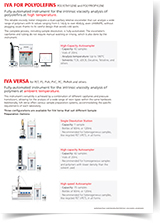
An overview of the Intrinsic Viscosity Analyzer high-temperature and ambient temperature models by Polymer Char
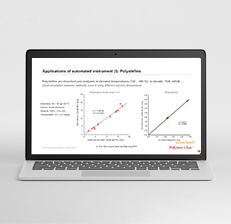
Webinar Brazilian Polymer Conference
Date: October 2021
Speaker: Alberto Ortín

June 2026
Tonica González, Felipe Cordero, Alba Cárdenas
Polymer Char
December 2025
F. Cordero, A. Cárdenas, N. Fernández
October 2025
F. Cordero, A. Cárdenas, A. Ortín, N. Fernández

Published in LCGC The Column
By Alba Cárdenas, Alberto Ortín, Pilar del Hierro
August 2024
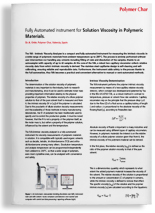
Published in Wiley Online Library
By Pilar del Hierro, Olivier Boyron, Alberto Ortín
December 2022
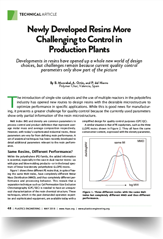
Published in Plastics Engineering (SPE)
May 2018
Pages 48-51
B. Monrabal, A. Ortín, P. del Hierro
Revised for publication in The Column
By Alberto Ortín, Pilar del Hierro
April 2018
Pages 34-38

Poster
Presented at XVIII Conference of the Specialized Group on Polymers (GEP)
2026
Poster
Presented at Pittcon Tradeshow
2025
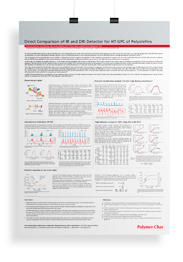
Poster
Presented at the 8th ICPC
2023
Poster
Presented at the 8th ICPC
2023
Poster
Presented at the GPC Conference
2015

